Data deduplication in Klio
Klio stores base backups in a Kopia repository.
Consecutive base backups of the same PostgreSQL cluster can share a lot of content. Between two runs relation files may be untouched, and the files that did change can have changed only for a small part. Keeping a full independent copy of every backup would multiply all of that unchanged data by the number of backups you retain.
Kopia avoids it by storing each distinct piece of data once and referencing it from every backup that contains it.
Content-addressable storage
When Klio uploads a base backup, Kopia splits the data into chunks, which it calls contents. Each content is identified by a hash of its own bytes — its content ID. Two chunks holding identical bytes therefore get an identical content ID, whichever file or backup they came from, so the repository only ever needs one copy of those bytes.
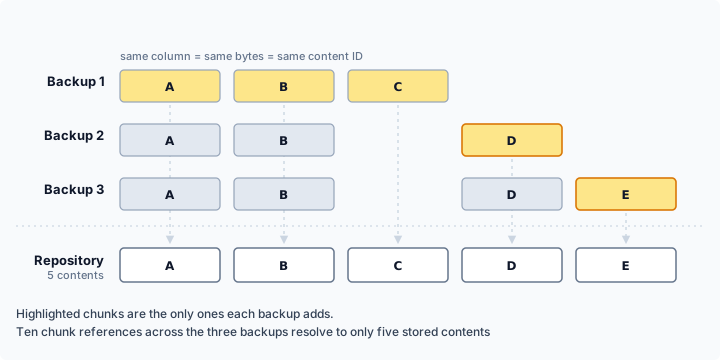
Because a chunk's identity comes from its contents rather than from its filename or its position in a file, this works across backups without Klio having to track what changed. Untouched relations produce the same content IDs as the one before it, and Kopia recognizes that it already holds them.
Sharing is not limited to consecutive pairs, either. A content introduced by one backup is reused by every later backup that still contains those bytes, so the cost of a backup depends on how much data changed since the last one rather than on how many backups came before.
What is deduplicated, and what is not
Deduplication applies to base backups only.
WAL files take a different path. They are not stored in the Kopia repository at all: Klio compresses and encrypts each segment and writes it to the WAL archive as an individual file. The size of the WAL archive is therefore driven by how much WAL your cluster produces and how long you keep it, not by how similar consecutive segments happen to be.
Sharing is repository-wide
A content is shared across everything in the same repository, not only across the backups of a single cluster. Each PostgreSQL cluster appears in the repository as its own Kopia host, but all hosts draw on one shared pool of contents. Where several clusters hold similar data, their base backups reinforce each other's deduplication.
Tier 1 and Tier 2 are separate repositories, so the sharing happens independently within each of them. See Architectures & Tiers.
Why deleting a backup may not free space
Because contents are shared, deleting a backup does not necessarily delete any data. A content has to stay for as long as any retained backup still references it, so removing one backup out of many may free nothing at all. The space is reclaimed later, by Kopia maintenance, once no backup points at a content any more.

For the full mechanism and what to do about a full disk, see How Disk Space Is Freed.